
When a row of trees comes off a shopping-center outparcel or an office lot in Springfield, the part everyone watches is the felling. The part that decides whether the site is actually usable afterward is what happens to the stumps, the roots and the ground they leave behind. A property manager who has only dealt with residential tree work tends to be surprised by how different the commercial version is: there are tenants parking next to the work zone, a landlord who wants the pad re-paved or re-planted on a schedule, and underground services running exactly where the roots are.

Why stumps on a commercial site are not a yard problem
In a back yard a stump can sit for a season while the owner decides. On a commercial lot it almost never can. A stump next to a parking aisle is a tripping and mowing hazard, a stump in a planting bed blocks the replacement the landscape plan calls for, and a stump beside a loading dock is in the way of the next truck. The decision to grind, pull or leave each one is usually made before the trees come down, because it changes how the crew fells the trunk and how low they cut it.
Grinding is the default on paved and landscaped sites because it removes the visible stump and the top of the root plate without opening a crater. Where a building pad or a new footing is planned, the whole root ball may need to come out instead, which is an excavation rather than a grind and is treated as one. The difference matters for what is under the ground.
Three days before anyone grinds
Grinding and root removal are digging, and the rule that applies to a fence post applies here. Virginia 811 asks that any digging project be reported three days before work starts so that buried utility lines can be marked, and the marking service is free. Its own list of what counts as excavation includes boring, ditching, grading, moving earth, trenching and demolishing, as well as simply digging a hole. A stump grinder cutting a foot or more below grade beside an irrigation main, a lighting conduit or a gas service is exactly the situation the locate is meant to prevent. On a commercial lot the as-built drawings are worth pulling as well, because private lines inside the property, such as parking-lot lighting circuits and irrigation, are not always covered by the public locate.
Overhead lines, service drops and the limits of what the utility does
Where a Springfield commercial strip has overhead distribution lines along its frontage and a service drop to each building, the utility's rules decide who may touch what. Dominion Energy clears nearly all of its neighborhood power lines on a four-year cycle, trimming a minimum of 20 feet above the primary distribution line and 15 feet to the side, and its scheduled work trims only limbs that rub against the service line running to a building. It states plainly that it does not cut down live or dead trees on or near the service line; that work is left to the property owner or their contractor, and the utility will disconnect the service line at no cost so it can be done safely. For a commercial removal that means the disconnect has to be scheduled with the utility before the crew date, not discovered on the morning of the job.
What the crew needs lined up on a tenant-occupied site
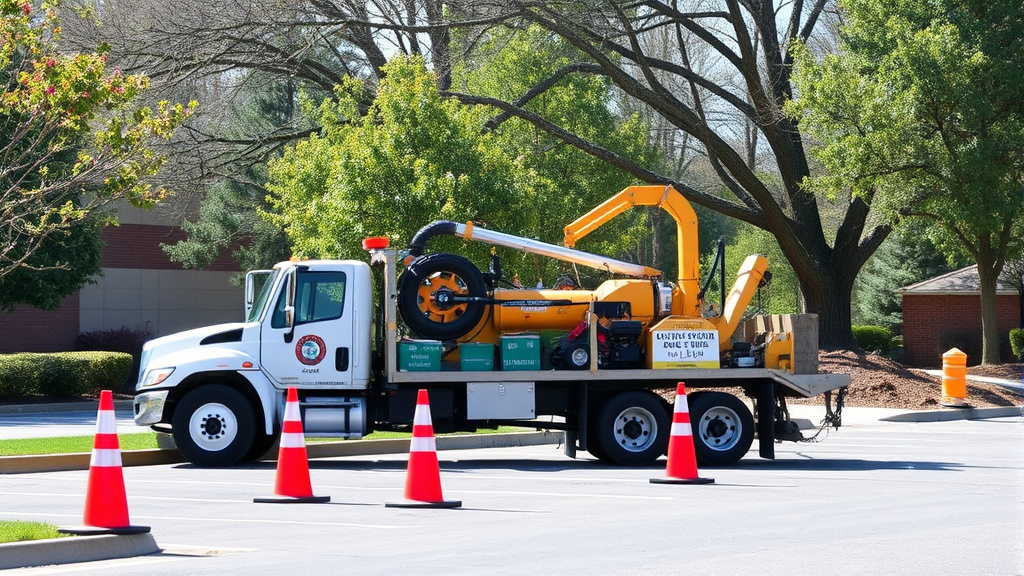
The preparation for taking trees off a commercial property is a longer list than for a house, and most of it is about the people and vehicles that will still be using the site while the work happens. A written account of what to arrange before the crew arrives, from parking closures and tenant notices to where the chip truck can stand, is set out in Taking Trees Off a Commercial Property in Northern Virginia: What to Line Up Before the Crew Arrives. The short version for Springfield sites is that the crew needs a cleared drop zone, a route for the truck and chipper that does not cross the tenants' entrance, and a decision on every stump before the first cut.
Two wrinkles come up often on older lots. The first is that frontage trees planted when a center was built tend to reach the end of their useful life together, so the removals come in groups rather than one at a time, and the stump plan has to cover a whole row. The second is drainage: a freshly ground stump bed in a low corner of a lot can stay soft for weeks unless the grindings are hauled and the hole is backfilled with something that compacts.
Grindings, roots and what goes back in the hole
A ground stump leaves a mound of wood chips mixed with soil, not a finished surface. On a residential job the chips are often raked out and left to rot; on a commercial site they usually have to go, because the landscape contract calls for turf or a new tree in that spot and chips decompose unevenly, settling into a depression a year later. The hole is backfilled with topsoil, compacted in lifts and seeded or planted. Where a tree is being replaced in the same bed, the arborist will generally recommend offsetting the new planting pit from the old root plate rather than planting into it.
Roots that have lifted a curb or a sidewalk slab are a separate conversation with the paving contractor. Grinding removes the stump, but the lateral roots under the concrete remain and will decay slowly; the slab is replaced after the roots are cut back, not before.
Who does the work on Springfield sites
G&V Tree Service has been a family-owned company in Springfield since 2001. Every crew it sends out is led by ISA certified arborists working to ANSI A300 standards, the company is a member of the Tree Care Industry Association and the International Society of Arboriculture, it is licensed and insured, and it does not use subcontractors, so the arborist who walks the lot with the property manager is the one whose crew does the felling and the grinding. Estimates are given on site at no charge, and for commercial and HOA properties the company works on a scheduled basis rather than one call at a time. Related reading on this site covers the rules that apply to stumps on Springfield lots and the choices an arborist weighs between grinding and pulling.
From the Commerce Street library to the office on Brandon Avenue
Richard Byrd Library at 7250 Commerce Street, which began as a storefront in 1958, moved into its current building in March 1965 and was renovated to LEED Gold in 2010, sits in the middle of Springfield's older commercial core; the G&V Tree Service office on Brandon Avenue is a few minutes away, and the route between them is mapped below.
G&V Tree Service Inc · 6434 Brandon Ave, Suite 204, Springfield, VA 22150 · (703) 569-2570
Common questions from property managers
Can the stumps be left and ground later? They can, but on a tenant-occupied lot a stump beside a parking aisle is a liability in the meantime, and a second mobilization costs more than grinding on the day of the removal.
Do we need to call 811 if the stumps are in a planting bed? Yes. Grinding is excavation, and irrigation, lighting and gas services often run through beds. Virginia 811 asks for three days' notice and the locate is free.
Will the utility take down a tree that is leaning on the service drop? No. Dominion trims limbs that rub the service line during its cycle but does not remove trees on or near it; it will disconnect the drop at no cost so a contractor can.